How I Automated a Medical Clinic's Entire Blog With Claude: A Real-World Playbook
Most “AI content automation” tutorials show you how to generate 50 mediocre posts in 10 minutes. This is not that.
This is a case study of building a production content pipeline for a premium aesthetic and wellness clinic. The writing has to be medically responsible, brand-consistent, and genuinely useful to educated patients in Delhi-NCR. Generic AI output would actively hurt the brand.
Here’s exactly what I built, why each decision was made, and what surprised me.
The Problem
House of Aetheria is a premium integrative clinic in Gurugram: dermatology, injectables, functional medicine, cosmetic surgery. The team has strong clinical knowledge but zero time to write. The blog had one post. The content opportunity was enormous and completely untapped.
The brief: publish 30 clinically accurate posts targeting high-intent search queries (e.g. “profhilo vs fillers gurugram”, “HIFU non-surgical facelift india”) without sounding like every other aesthetic clinic blog in India.
The Architecture
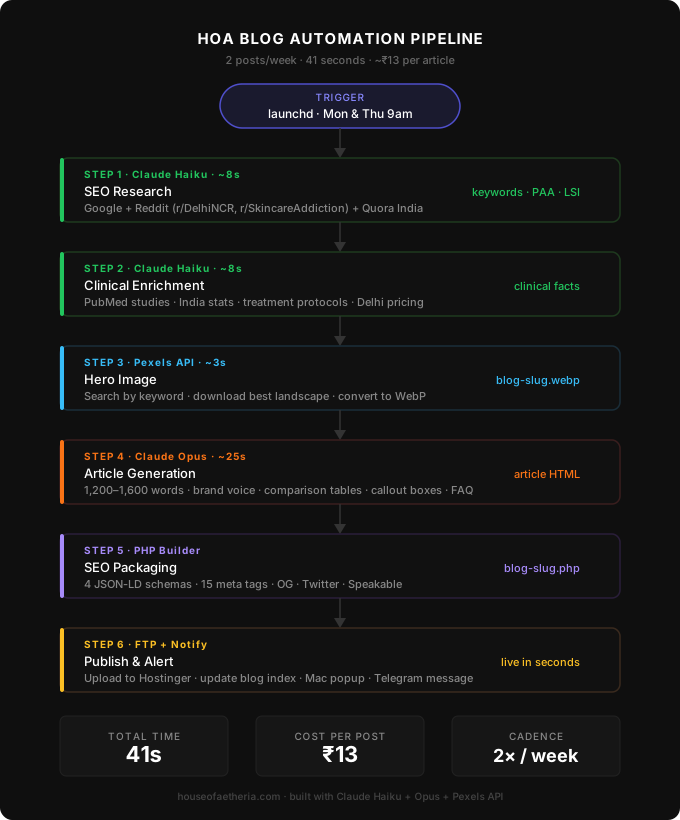
The system is a Python script that runs on a Mac scheduler. No cloud server, no monthly hosting cost. Here’s the full pipeline:
Stage 1: SEO Research (Claude Haiku, ~8s)
The first insight was separating SEO research from article generation into two separate API calls using two different models.
Haiku handles research. It’s fast, cheap, and good at structured extraction. The prompt searches Google but also explicitly targets Reddit (r/DelhiNCR, r/SkincareAddiction, r/india) and Quora India. The difference is significant: Google gives you what’s ranking; Reddit gives you what patients are actually worried about at 11pm before their appointment.
Output: keywords, People Also Ask questions, LSI terms, and real community concerns.
Stage 2: Clinical Enrichment (Claude Haiku, ~8s)
A second Haiku call specifically for clinical fact-finding, separate from SEO. It searches PubMed for recent studies, finds India-specific market stats, extracts current treatment protocols, and pulls real Delhi/Gurugram pricing from competitor pages.
This data is injected into the Opus prompt as a structured “CLINICAL FACTS” block. The instruction: weave these naturally, do not list them verbatim.
Stage 3: Image Sourcing (Pexels API, ~3s)
Auto-searches Pexels by keyword, downloads the best landscape image, converts JPEG to WebP. Saves ~40% in file size versus JPEG. Zero manual work. The right image is waiting before the article is even written.
Stage 4: Article Generation (Claude Opus, ~25s)
Opus writes the article with all context injected: SEO data, clinical facts, patient concerns, available images, brand voice rules. The system prompt took the most iteration. It bans specific words (“amazing”, “revolutionary”, em dashes, AI-tell words like “delve” and “leverage”), enforces a 6-section structure, and defines exact HTML patterns for comparison tables, stat callout boxes, and inline images.
The key rule that made the biggest difference: never use web search during generation. Early versions used it and Claude started outputting meta-commentary and self-checks instead of HTML. Research happens before writing. Writing uses no tools.
Stage 5: PHP Assembly
The site is flat PHP on Hostinger, no CMS, no framework. The script builds a complete PHP file with:
- 4 JSON-LD schemas (BlogPosting with wordCount/timeRequired/author credentials, FAQPage, BreadcrumbList, Speakable WebPage)
- 15 meta tags including og:site_name, og:locale, article:author, article:published_time
- Full brand template with self-hosted IvyPresto Display and IvyMode fonts
Stage 6: Auto-publish
FTP upload to Hostinger, blog index card inserted (with duplicate prevention), JSON-LD blogPost array updated. Then Mac notification + Telegram message to phone with the live URL so I can check the post within minutes of it going live.
The Mistakes That Taught Me The Most
Rate limits are a model-level problem, not an account-level problem. Early builds hit 429 errors constantly with two consecutive Opus calls. The fix: use Haiku for research and Opus for generation. They have separate rate limit buckets. No sleep() needed between calls. Per-post time dropped from ~105 seconds to ~41 seconds.
Case sensitivity killed images silently. Hostinger runs Linux. injectables-Dermal-Filler.webp and injectables-dermal-filler.webp are different files. The site showed broken images for a week before I traced it. Now there’s a validate_category_images() function that checks file existence before passing paths to Claude.
Callout boxes need a short stat. The design has a large-font stat span next to explanatory text. When Claude wrote a full sentence in the stat span, it overflowed the box at large font sizes. The system prompt now says: “stat must be SHORT: a number or 2-word phrase only, never a sentence.”
The blog card was being inserted on every dry run. Had to add slug-checking before insertion so re-runs don’t create duplicate cards. Found out the hard way after the same post appeared four times on the blog page.
Web search during generation breaks everything. When tools are available during article generation, Claude hedges. It adds caveats, checks its own output, summarises sources. You get meta-content instead of actual content. The fix is architectural: all research happens in separate upstream calls, and generation gets a clean context with no tools available.
The Numbers
- Time per post: 41 seconds
- Cost per post: ~₹13 in API calls (two Haiku + one Opus)
- Posts remaining: 29 topics
- Cadence: Monday + Thursday 9am, fully automated
- Done by: mid-July 2026, without touching anything
What Surprised Me
The hard part wasn’t the code. It was defining what “good” looks like for our patients, and teaching the system to write like a trusted doctor rather than a content farm.
The system prompt is the real product. The Python is just plumbing.
Every clinic wants content. Most use generic tools and get generic output. The competitive advantage isn’t in using AI. It’s in having a tight enough brand voice and clinical standard that the AI has something real to work from.
The automation handles execution. The thinking still has to come from you.
That’s true for every AI tool I’ve built. The output is only as good as what you put in.
Built with: Python, Anthropic API (Haiku + Opus), Pexels API, ftplib, launchd, Telegram Bot API. Running live at houseofaetheria.com.
Enjoying insideai? Every week I publish new AI experiments and honest breakdowns. Subscribe free.